Understanding the Home Buying Process.
Every first consultation started from zero — “LVR”, “offset” and “pre-approval” re-explained while the clock ran down on actual advice. So a Loan Market broking practice now issues clients a five-week micro-course, free, before they arrive: scenario-based, AI-tutored, and built to make buyers broker-ready.
Consultations were
starting from zero.
A practising mortgage broker kept meeting the same three problems. Key terms arrived misunderstood, re-explained in almost every first meeting. High-stakes decisions plus low financial literacy left clients anxious, overloaded and stalled. And every minute spent on the basics was a minute not spent on personalised, higher-value guidance.
Existing consumer resources — MoneySmart, the big banks’ home-buying hubs — offer solid information but present it statically: no feedback, no practice, no reflection.
The brief had a dual purpose: build the client’s confidence before the consultation, and hand the broker their advice time back.
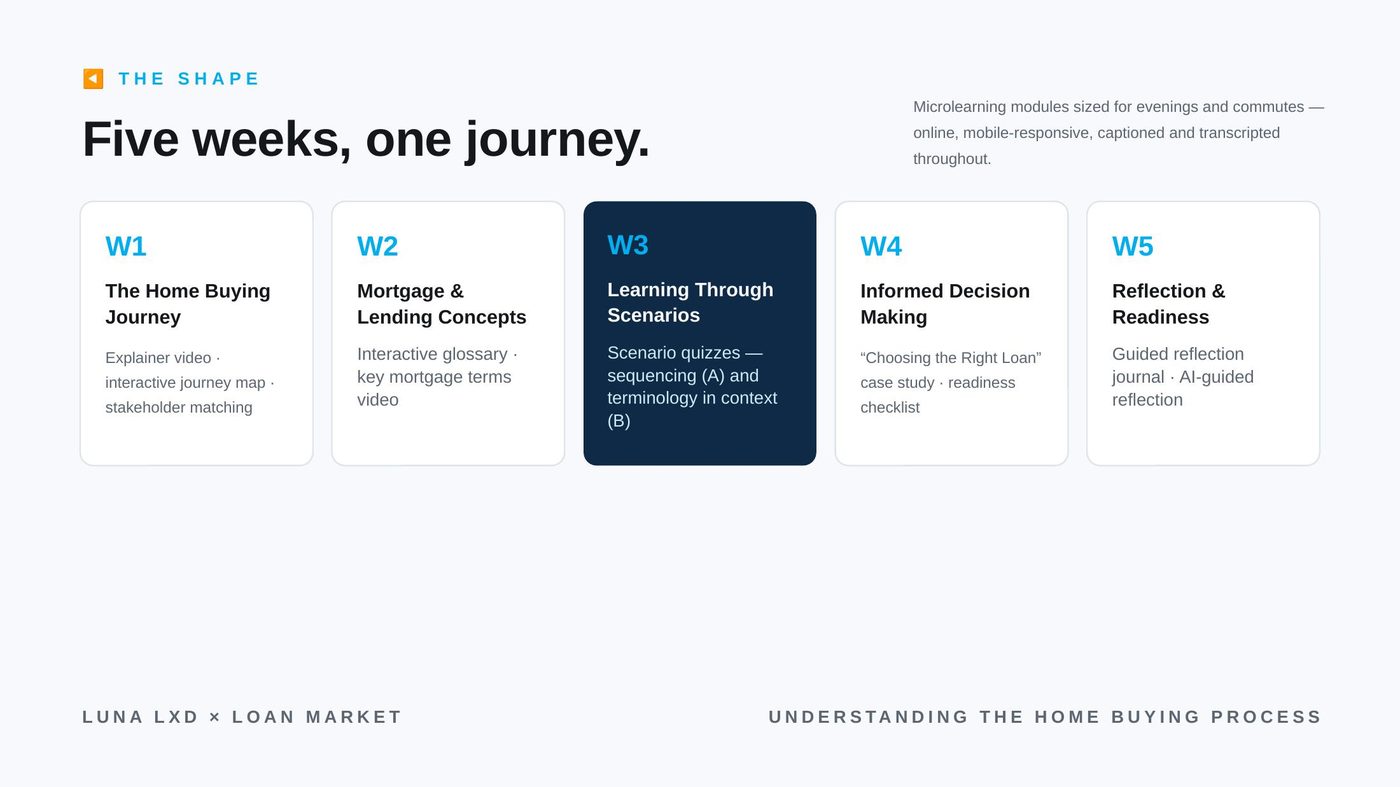
Five weeks,
one journey.
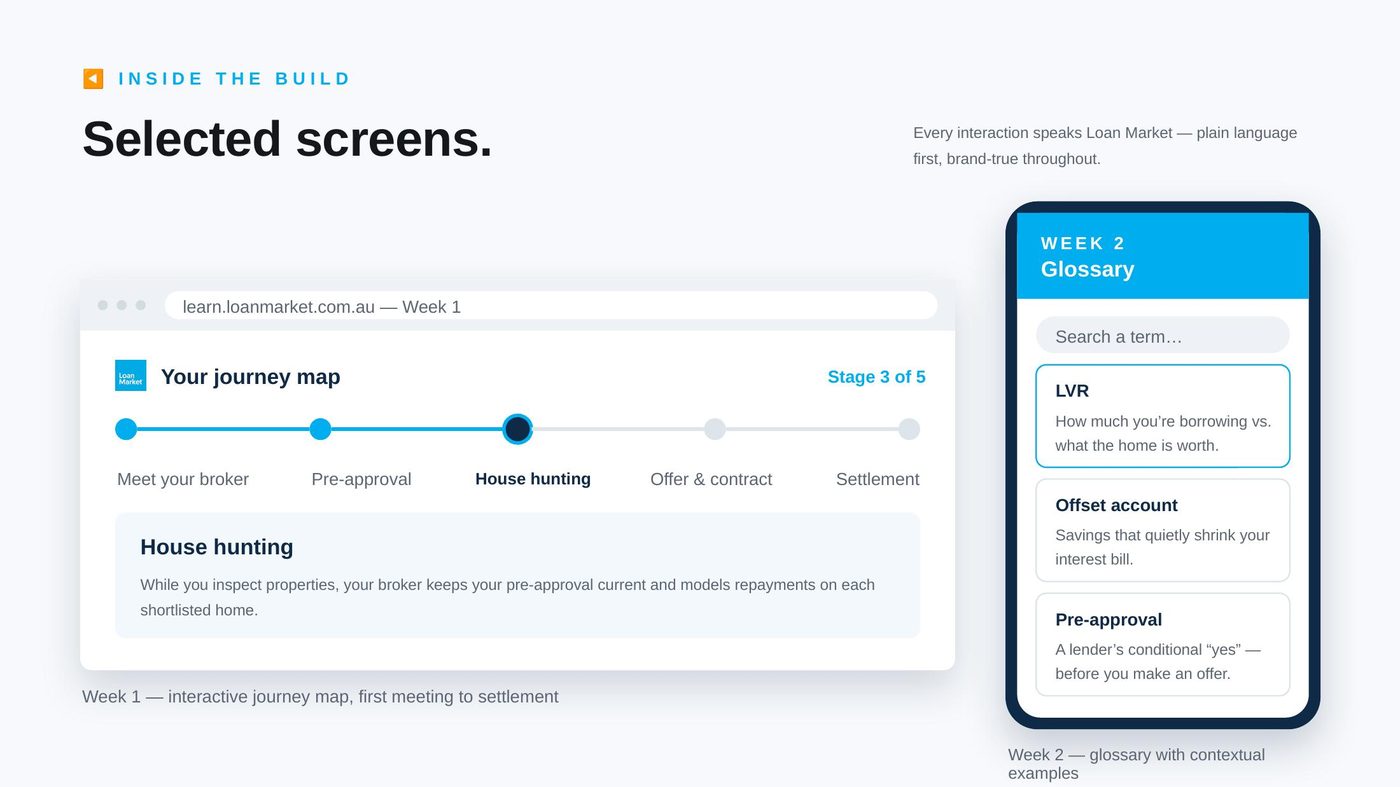
Selected screens.
From the project case-study deck — every interaction speaks Loan Market: plain language first, brand-true throughout.


How it came together.
The design started where the pain was: structured research with the broker SME surfaced the recurring misconceptions — “LVR”, offset accounts, the pre-approval sequence — the decision barriers, and the workflow cost of re-explaining them. Those findings were benchmarked against existing consumer education, which informs but rarely lets a learner practise or reflect.
The response is a five-week micro-course built backward from three outcomes: know the journey, speak the language, make informed early decisions. Every activity and assessment maps to one of the three — Backward Design shaping the structure, Constructive Alignment keeping it honest. Nothing in the course exists that doesn’t serve an outcome.
Adult learners buying a home are motivated, anxious and time-poor — so the course meets them there. Microlearning modules are sized for evenings and commutes, mobile-responsive, captioned and transcripted. Scenario quizzes rehearse the real sequence of decisions with reasoning-based feedback, and the “Choosing the Right Loan” case study asks learners to weigh genuine trade-offs rather than recall definitions.
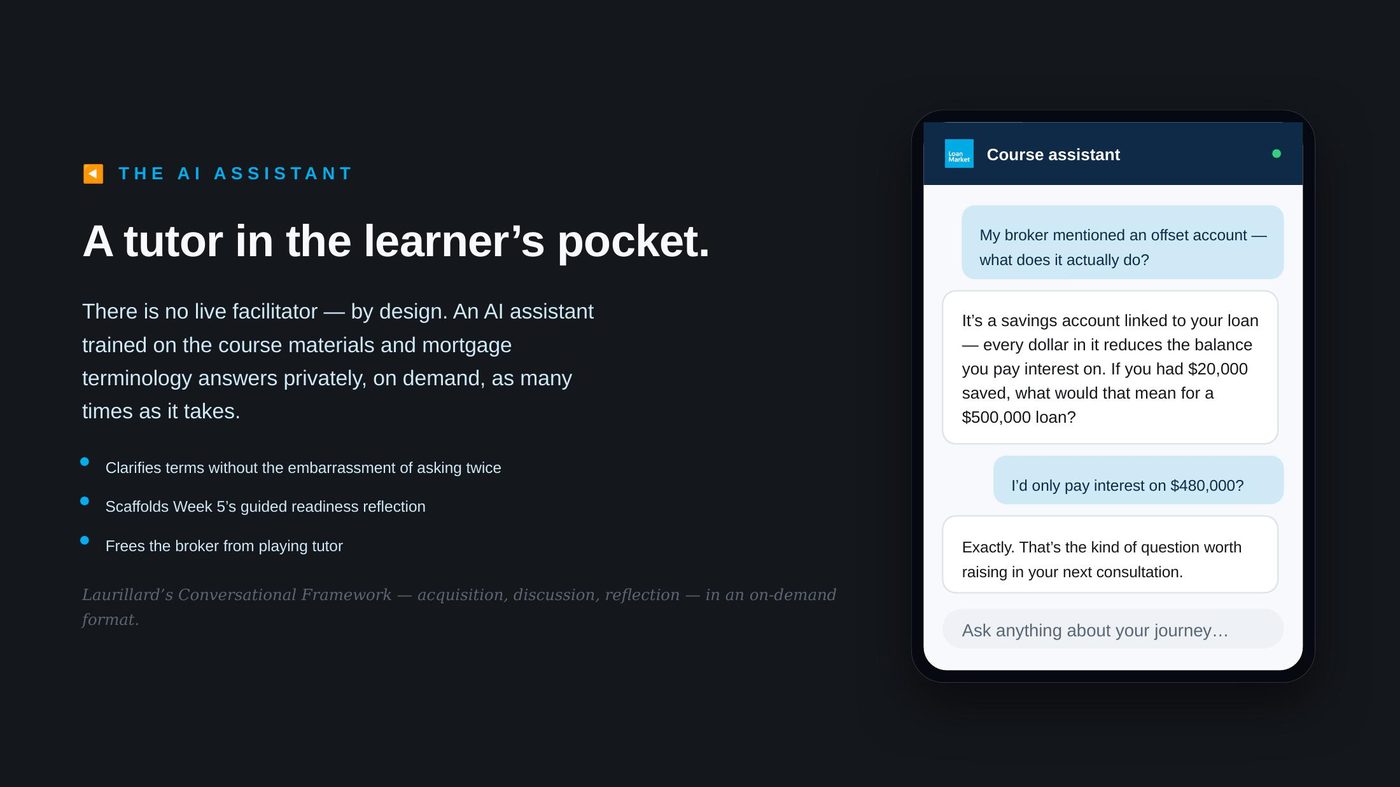
The distinctive layer is the AI assistant. There’s no live facilitator — by design. An assistant trained on the course materials and mortgage terminology answers privately, on demand, as many times as it takes: clarifying terms without the embarrassment of asking twice, and scaffolding Week 5’s guided readiness reflection.
The hardest design problem was absence: no tutor, no cohort, no classroom — deliberately, because the whole point was to stop the broker playing tutor. Laurillard’s Conversational Framework supplied the answer’s shape — learning needs cycles of acquisition, discussion and reflection — and the AI assistant supplies those cycles on demand, in private, at the learner’s pace.
The honest counterweight, raised and resolved with the SME: AI assistance can erode a learner’s accountability. Here, the motivation is structural — learners are weeks from the largest financial decision of their lives, and every module moves them closer to it. The course doesn’t have to manufacture engagement; it has to respect it — and stay out of its way.
One course, two beneficiaries.
The course is live — issued free by the broker as part of the service, working for both sides of the desk. Clients arrive fluent in the language of the loan: steps, stakeholders and terms already in hand. The partnering broker reports consultations that now start at advice rather than definitions — sharper, more personal, and spent on the decisions that actually need a professional in the room.