Student Success Portal.
Queensland needed 12,000 more nurses — and Mater Education needed its Diploma of Nursing students to make it to the finish line. Backed by an Advance Queensland grant, I designed and delivered the entire student-success ecosystem: portal, Clinical Skills Videos, placement guide, AI chatbot content and face-to-face sessions. One designer, the whole program.
Get more students
to graduation.
Enrolments in Mater Education’s 18-month Diploma of Nursing jumped 28 per cent during COVID — but enrolling isn’t finishing. With Queensland projected to need an extra 12,000 nurses by 2025, every student lost to attrition was a nurse the state wouldn’t get.
Mater ran an open innovation challenge through Advance Queensland for a stronger student support system. Eduvidd won it — the first project signed under the new Private Sector Pathways Program, co-funded at $94,000.
The brief: an immersive, holistic support experience for students across Brisbane and Townsville — before, during and beyond the classroom.
An ecosystem,
not a course.
Take the tour.
The 90-second portal tour — scripted, filmed and edited in-house — then real screens and artefacts.


How it came together.
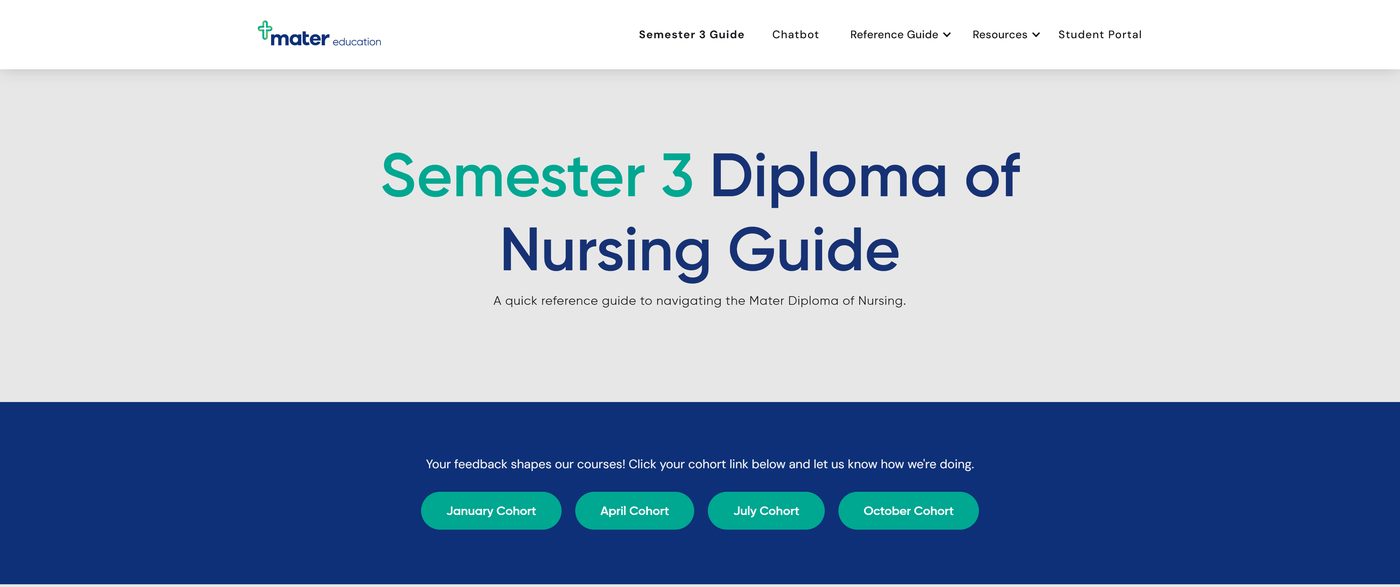
Attrition rarely has one cause, so the response couldn’t be one course. The project began with research — where students actually struggled, gathered from Mater’s executives, clinical educators and the students themselves — and the findings shaped an ecosystem: a semester portal for orientation and wayfinding, skills videos for clinical confidence, a placement guide for the leap into practice, a chatbot for the questions in between, and facilitated sessions to keep the human connection.
I led the project end-to-end — research, stakeholder engagement, instructional design, production and delivery — with the platform build and chatbot integration handled by the Eduvidd founder. Two people, one complete program, two campuses.
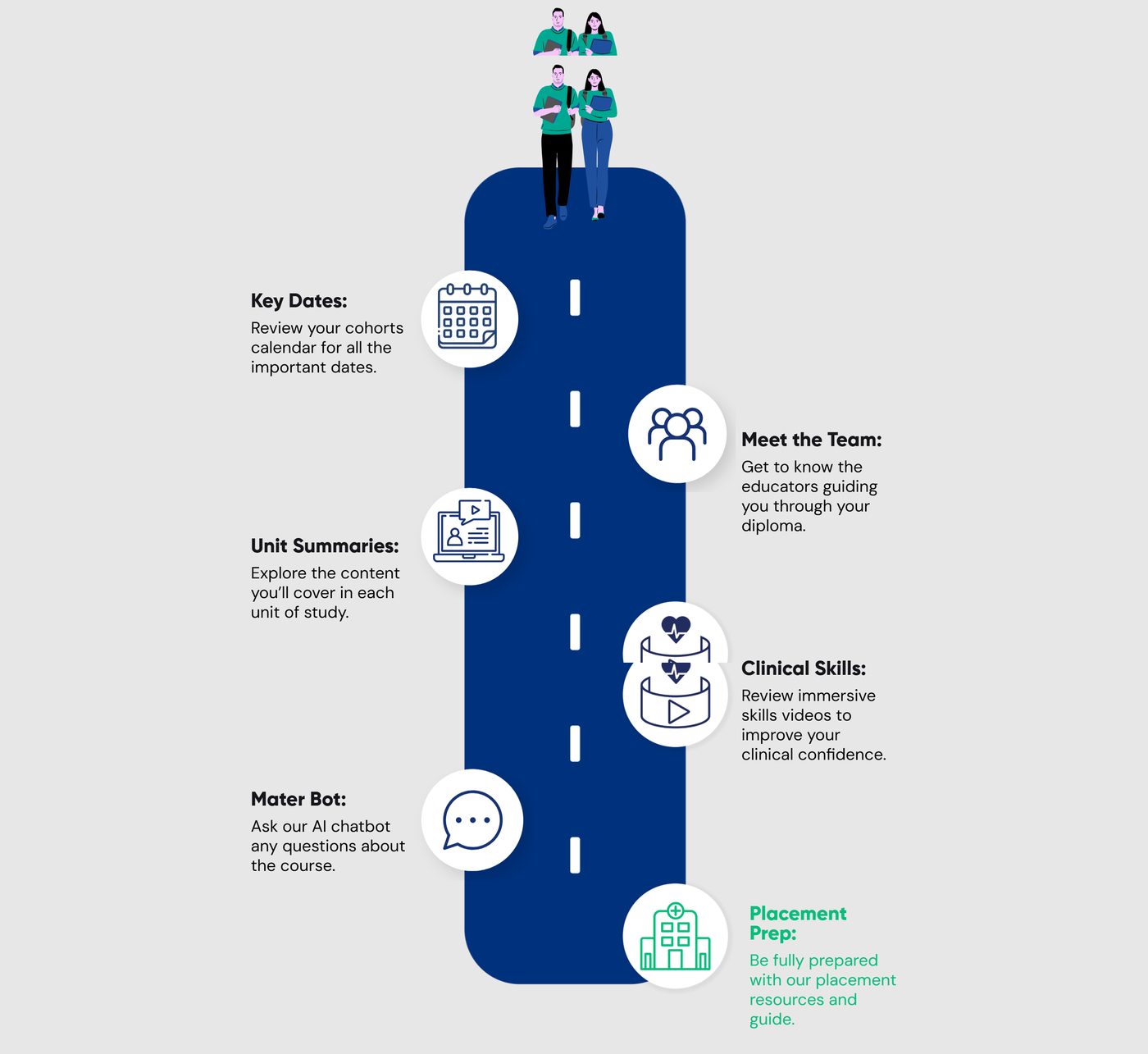
The portal was designed around a student’s actual semester: a visual journey map from key dates through to placement prep, so a stressed first-year always knows what’s next. The Big Picture gave every unit a video summary with its learning outcomes and assessment guides — the whole semester, legible in an afternoon.
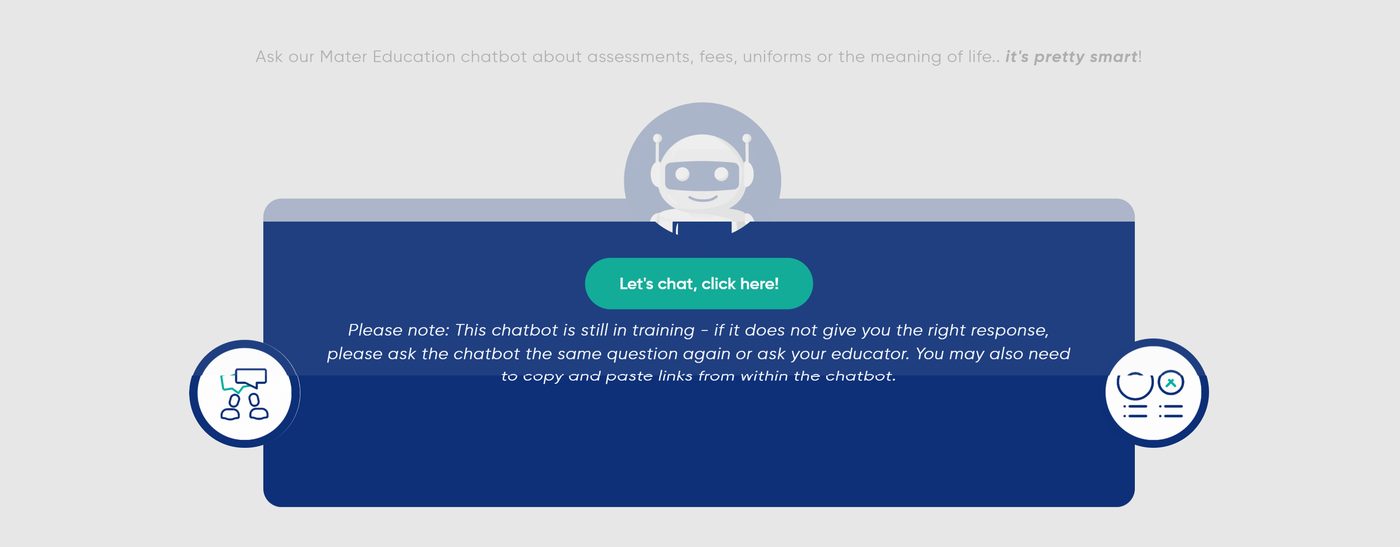
Skills Station paired first-person clinical films with simulation lab guides; I handled the filming, the clinical annotation and the edit, so the clinical detail survived the production process. And MBot was fed content architected from Mater’s own student-facing documentation — meaning its answers matched what the institution actually says, and its question logs told us exactly where students were getting stuck.
The hard part wasn’t any single artefact — it was coherence. Portal, films, primer, chatbot and classroom sessions all had to feel like one program, across two campuses and four intakes a year, delivered by a team of two. That took ruthless scoping in Miro workshops with Mater’s executives and educators, and a design system disciplined enough that every touchpoint — a PDF page, a video lower-third, a portal card — was recognisably the same voice.
The second challenge was the chatbot: useful answers required content grounded in Mater’s real documentation, structured so the AI could retrieve it accurately — information architecture as much as instructional design.
Attrition down, 7.1x back.
The program launched across Brisbane and Townsville and ran for two years, supporting eight Diploma of Nursing intakes. Mater’s Education Director reported measurable results: student attrition fell across the first two semesters, retaining $345k+ in revenue — a 7.1x return on the program investment within months — with the chatbot tested to better than 90 per cent answer accuracy. The partnership was also documented publicly, in a Queensland Government innovation story and Mater’s 2022–23 Annual Review.
Receipts · Advance Queensland innovation story · Mater Annual Review (p16) · the portal